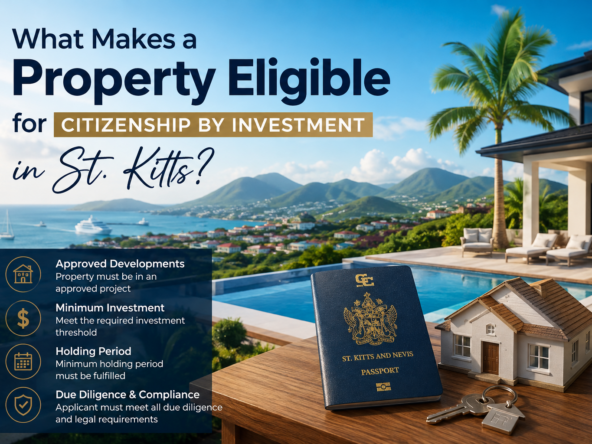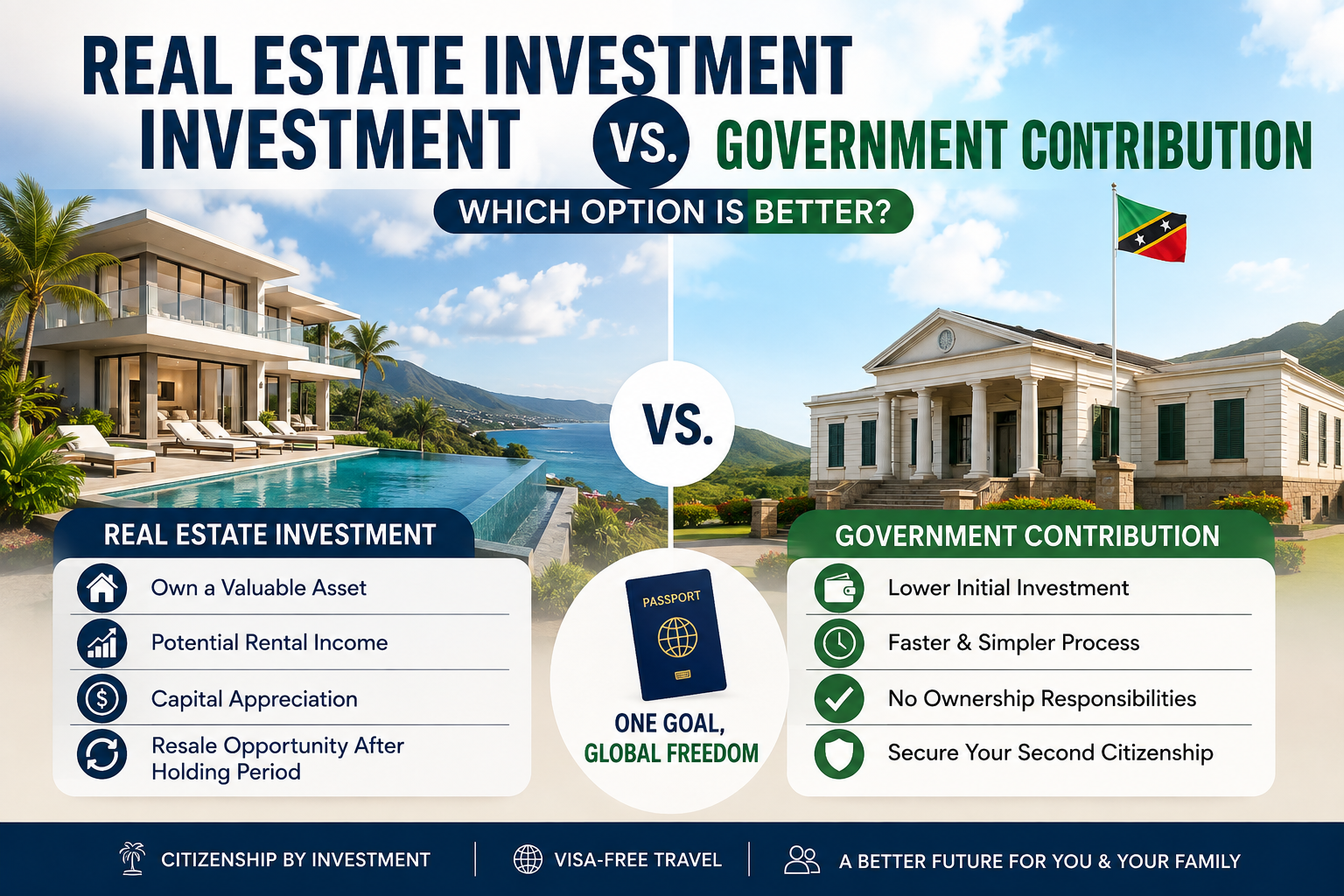
Choosing the right Citizenship by Investment (CBI) option is one of the most important decisions for international investors seeking a second passport. Most Caribbean Citizenship by Investment programs, including St. Kitts and Nevis, offer two primary investment routes: real estate investment and government contribution.
Both options provide access to citizenship, but they serve different financial goals, investment strategies, and lifestyle preferences. Understanding the differences between these pathways can help you make an informed decision that aligns with your long-term objectives.
In this guide, we’ll compare real estate investment vs. government contribution, highlighting the advantages, disadvantages, and ideal candidates for each option.
Understanding Citizenship by Investment
Citizenship by Investment allows qualified foreign investors to obtain citizenship by making an approved financial contribution to a country’s economy.
Benefits often include:
- Visa-free or visa-on-arrival travel
- Diversification of assets
- Global business opportunities
- Family inclusion
- Tax planning opportunities
- Access to a peaceful Caribbean lifestyle
The two most popular investment routes are:
- Government Contribution
- Approved Real Estate Investment
What Is a Government Contribution?
A government contribution is a non-refundable financial contribution made directly to a government-approved development fund.
These funds typically support:
- National infrastructure
- Education
- Healthcare
- Climate resilience
- Economic development
Once approved, applicants receive citizenship without owning any physical assets.
Advantages of Government Contribution
1. Lower Initial Investment
Government contributions generally require a lower investment than purchasing qualifying real estate.
This makes the route attractive for applicants focused solely on obtaining citizenship.
2. Simple Application Process
Since there is no property purchase involved, applicants avoid:
- Property searches
- Legal transfers
- Property management
- Maintenance responsibilities
The overall process is usually straightforward.
3. Faster Completion
Without real estate transactions, applications can often move more efficiently after due diligence approval.
4. No Ownership Responsibilities
Applicants never need to worry about:
- Repairs
- Rental management
- Property taxes
- Insurance
This option suits investors seeking simplicity.
Disadvantages of Government Contribution
Although convenient, government contributions have limitations.
Non-Refundable Investment
Unlike property ownership, the contribution cannot be recovered.
Once paid, the investment is gone permanently.
No Financial Returns
Applicants do not receive:
- Rental income
- Property appreciation
- Equity growth
The return is citizenship alone.
What Is a Real Estate Investment?
Under the real estate option, applicants purchase government-approved property that meets the minimum investment requirement.
Eligible properties may include:
- Luxury villas
- Beachfront condominiums
- Resort residences
- Boutique hotel shares
- Vacation homes
Many developments are professionally managed.
Advantages of Real Estate Investment
1. Own a Valuable Asset
Instead of making a non-refundable payment, investors acquire property that may appreciate over time.
This creates long-term value beyond citizenship.
2. Rental Income Potential
Many Caribbean resorts offer rental management programs.
Owners may earn income while not occupying the property.
This helps offset ownership costs.
3. Capital Appreciation
As tourism grows and infrastructure improves, property values may increase.
Although appreciation is never guaranteed, quality developments often perform well over the long term.
4. Vacation Home
Investors gain access to a personal Caribbean residence for holidays or retirement.
This lifestyle benefit appeals to many international families.
5. Resale Opportunity
Many Citizenship by Investment programs allow investors to sell qualifying properties after the required holding period.
This enables partial or full recovery of the original investment, depending on market conditions.
Challenges of Real Estate Investment
Real estate ownership also comes with responsibilities.
Higher Initial Cost
Property investments usually require more capital than government contributions.
Ongoing Expenses
Owners may need to pay:
- Maintenance fees
- Property management charges
- Insurance
- Utility costs
- Taxes (where applicable)
Market Risks
Property values can fluctuate based on:
- Tourism demand
- Economic conditions
- Local market trends
No investment is risk-free.
Side-by-Side Comparison
When deciding between a government contribution and a real estate investment for Citizenship by Investment, it’s helpful to compare the key differences:
Initial Cost
- Government Contribution: Usually requires a lower upfront investment.
- Real Estate Investment: Typically involves a higher initial investment due to property purchase costs.
Refundability
- Government Contribution: The contribution is non-refundable.
- Real Estate Investment: Your investment may be partially or fully recoverable if you sell the property after the required holding period, subject to market conditions.
Asset Ownership
- Government Contribution: You do not own any physical asset.
- Real Estate Investment: You own an approved property, providing a tangible long-term asset.
Rental Income
- Government Contribution: Does not generate any income.
- Real Estate Investment: Many approved properties can generate rental income through professionally managed rental programs.
Property Appreciation
- Government Contribution: Offers no opportunity for capital growth.
- Real Estate Investment: Property may appreciate in value over time, depending on market performance.
Ongoing Costs
- Government Contribution: No maintenance or ownership expenses after the contribution is made.
- Real Estate Investment: Property owners should expect ongoing costs such as maintenance fees, insurance, and management expenses.
Management Responsibilities
- Government Contribution: Requires no ongoing management.
- Real Estate Investment: Involves minimal to moderate management, although many developments provide professional property management services.
Investment Recovery
- Government Contribution: The funds cannot be recovered.
- Real Estate Investment: There is potential to recover your investment by selling the property after the mandatory holding period, depending on market demand.
Who Is It Best For?
- Government Contribution: Ideal for applicants seeking the quickest and simplest route to citizenship without the responsibilities of property ownership.
- Real Estate Investment: Better suited for individuals who want to combine Citizenship by Investment with long-term wealth preservation, property ownership, and potential financial returns.
Which Option Is Better?
The answer depends on your financial goals.
Choose Government Contribution If:
- You want the simplest route.
- You do not want to manage property.
- Citizenship is your primary objective.
- You prefer lower upfront costs.
- You are not interested in long-term investment returns.
Choose Real Estate Investment If:
- You want to build wealth while obtaining citizenship.
- You like owning international property.
- You plan to visit or retire in the Caribbean.
- Rental income interests you.
- You prefer an investment with resale potential.
Factors to Consider Before Deciding
Before choosing your investment route, consider:
Budget
Determine how much capital you’re comfortable investing.
Investment Goals
Are you seeking:
- Citizenship only?
- Asset diversification?
- Passive income?
- Long-term appreciation?
Your goals should influence your decision.
Family Plans
Some investors purchase vacation homes their families can enjoy for generations.
Others simply want travel freedom.
Risk Tolerance
Real estate involves market exposure, while government contributions offer certainty but no financial return.
Why Many Investors Choose St. Kitts and Nevis
St. Kitts and Nevis remains one of the world’s most respected Citizenship by Investment destinations because of its:
- Long-established CBI program
- Strong international reputation
- Stable political environment
- Beautiful Caribbean lifestyle
- Attractive real estate developments
- Opportunities for global mobility
Whether you select government contribution or approved real estate, choosing the option that aligns with your financial objectives is essential.
Frequently Asked Questions (FAQs)
1. Which option is cheaper: real estate investment or government contribution?
Government contribution generally requires a lower initial investment, but it is non-refundable. Real estate usually requires more capital but offers ownership of a tangible asset.
2. Can I earn income from a government contribution?
No. Government contributions do not generate rental income or financial returns. Their primary benefit is obtaining citizenship.
3. Can I sell my real estate investment later?
Yes. In many Citizenship by Investment programs, approved real estate can often be sold after the mandatory holding period, subject to the program’s rules.
4. Is real estate investment risk-free?
No. Like any property investment, returns depend on market conditions, tourism demand, and the performance of the local real estate market.
5. Which option is better for retirement planning?
Real estate investment may be more suitable for retirees who want a vacation home, potential rental income, and long-term property ownership alongside Citizenship by Investment.